Online Jewelry Training Classes for Metalsmiths
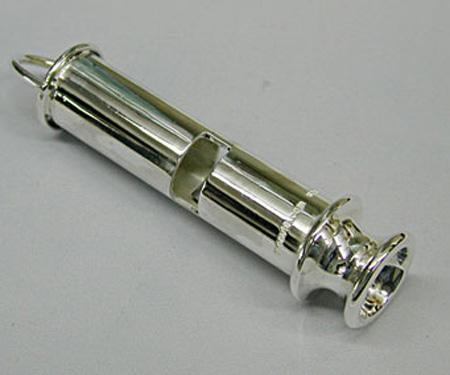
Making a whistle is somewhat esoteric but still an interesting and challenging project. It all started with a commission from a captain of a racing yacht. He had lost his whistle and he wanted me to make one that served 2 purposes. Foremost as whistle and secondary as jewelry in the shape of a cross which he could wear all the time. . When competing in yacht racing he used the whistle to get the attention of his crew team because the sounds of wind and sea drown out his voice.
A year or so goes by, and one day I wake up and I realize that I can't actually remember, how I had made the captains whistle. Luckily I had, in my research, made four or five test samples, firstly out of copper tubing and then out of silver, and I still had these attempts in my silver box of experiments. That is why I made this tutorial on how to make a whistle in silver.
This free tutorial follows the same format as all my other free and premium tutorials. This gives you a good insight into the technical teaching methodology.


We start with a piece of flat, annealed silver, the size shown. I rolled this down to .8mm thick, but I am sure other thicknesses will be good too, like 1mm or 1.2mm.
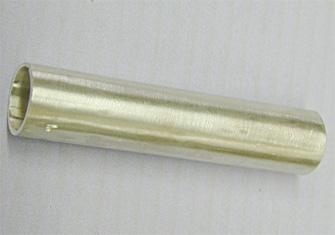

I make tubing by bending it round and soldering it up into a tube that has a diameter of 11mm on the inside. One can, of course, buy the right diameter tubing, but what I do is to cut the plate so that it will, when bent roughly round, form a 10-10.5 mm inside diameter. I solder it up and then I tap an 11mm ball punch through the tubing. A bit more of taping and bingo I have a perfectly round piece of tubing. ( my ball punches diameter are the same as the shaft diameter, a very handy thing)
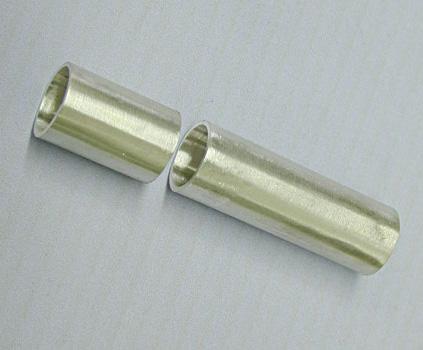

Then I saw the tube about a third of the way up. The first picture shows the whistle to be 60mm long. In actual fact it turned out to be 50mm long. The reason is that the longer the front of the whistle is the lower the pitch. And the shorter, the higher the pitch.


The front section of the whistle is cut out as shown. The depth of the cut is 5.5mm. The thickness of the 'posts' is 5mm. Those measurement are not finite. There is, within reason quite some leeway.


Now comes the critical part. This plate is .5mm thick. I pierce it out carefully.


Then I file the lips just so that the plate fits very snugly into the bottom section.


Then I solder in the plate so that it is a millimeter or so recessed from the top. Also, I have run a .7mm barrel bur so that the plate and the inner walls have an equal gap. This is all rough still. I will take sandpaper strips and smooth the .7mm gap out and use bristle brushes and brush finish the inside later.


At this stage I can hold the two pieces together and make the thing whistle. It's a bit finicky, but at least I know it will work.


Now I need to make the mouthpiece. I roughly shape a 'washer' of silver.


Which is filed to about the same diameter as the whistle section. It is about 9mm wide, but in retrospect I could have made it 11mm wide. It would fit my teeth and lips better when blowing the whistle


Then I file it with a 6mm rattail file ( a round file that is not tapered) and make a circle of silver. The wire is 2mm thick.


This circle I solder on just so that the bottom part of the whistle will fit in snugly. This looks good and hides the joint.


Then I make a flat washer 2mm thick and solder that onto the other side of the mouthpiece.


Like this.


Here I am about to solder the two components together


These are the three sections of the body of the whistle.


Mouthpiece soldered on.


Experimental part doesn't alway deliver desired result. Instead of just putting a nice gold cap on the end of the whistle, why not put a amethyst there instead. Bad idea. The whistle simply ceased to whistle. I assume the pavilion of the stone upset the air flow. Back to the tried and tested.


I soldered a gold cap on instead.. The two grooves are there to accept the bail of the whistle


When the whistle is soldered together, it is essential that the posts and the whistle plate align. The whistle will not work if they are at 90 degrees to the posts.


Here the whistle is soldered together, ready to be finished off.
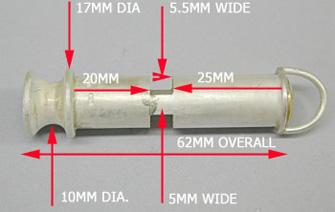

Measurements and dimentions of the whistle.


The commissioned project designing the whistle into a jewelry piece.
Often custom orders have very specific symbolism build into their creation which needs careful planning and consideration to achieve the desired result. The function of the whistle was not compromised by adding the external decorative arms (tubes).
or select other projects from Jewelry Making Tutorials List
Sandra wrote : "Thank you for the whistle tutorial! I made these based upon your instructions.
You do great work and your information is valued."
If you have any questions or wish to be notified of any new tutorials that are posted, email me.

This content is the intellectual property of Hans Meevis. More information on our Copyright and Privacy Policy