Online Jewelry Training Classes for Metalsmiths
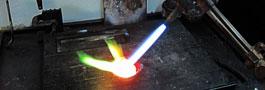
These are not scientific experiments. Nor scientific desertatations. This is just me messing around in my workshop, practicing medieval alchemy. In modern times.
I first read about purple gold in a magazine called Aurum in 1984. I only acquired som in 1998 from a company call Mintek, in South Africa. I gave them my fine gold and they made me some buttons of material.
This is my experiences in working purple gold
Firstly, purple gold is not malleable. It cannot be mechanically deformed, bent or stretched in any way in the manner that 'normal' gold can. When the gold is made it contains an alloy of more or less 75-80% fine gold and 20-25% aluminum. These are melted under an inert atmosphere, or in a vacuum oven. The result is known as an 'inter metallic compound". In a paper of the world gold council (no longer available on their website) they say that purple gold tarnishes easily. I have found this to be untrue. It does tarnish, but only as fast as 18kt yellow gold. Basically, if you work in purple gold you will treat is as a gemstone. All my purple gold jewelry that I have made, I have treated the material as such.

However, recently I purchased a dental vacuum oven.
This oven is circa 1980, analogue and in perfect condition. It has got a separate vacuum pump. The first thing that I did after cleaning, drooling, and installing it was to see what happens when you put gold and aluminum in it. Thusly:

This was gold in the correct 18kt proportions.

I just used two soldering pads that I cut to size and then ground some concave depressions in. Then I put a little brazing flux in. I told you this is alchemy!

Then I put the soldering blocks on top of each other, so forming a little hollow in them. I put them in the oven at 1150º Celsius under vacuum and when they reached the temperature, I held it there for 4 minutes. This is an arbitrary time, but it seems about right.

This is what it looks like when it comes out. Notice that is is not melted in a nice sphere as normal metal would. Remember that this might not be the case with sophisticated equipment in a fancy laboratory. I have a standard jewelry workshop with a bent to alchemy :) I am going to try get some high temperature ceramic to melt in. The solder pad absorbs all of the flux (which might or might not be a good thing, I don't know).

So this is what it look when it cools down. A very wrinkly surface and black.

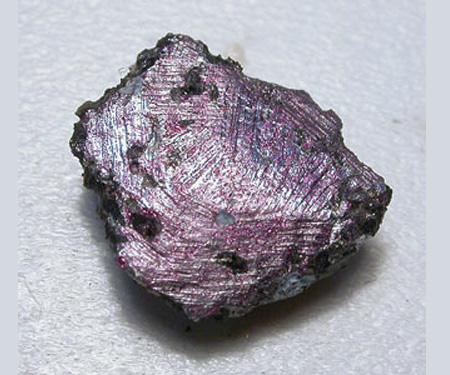
After I pried it out, I rough filed it and this is what it looked like.

This is what it looked like after a crude polish. It is actually a better colour that the picture shows. The stuff is difficult too photograph on the fly....

I also made a mixture of 90% gold and 10% aluminum and lo and behold! no purple colour. Most amazing. I am going to, in future experiments, play around with various mixture percentages and materials. Also to see if I can solder the stuff under vacuum. But its expensive. I can't lock up too much of my gold in experiments.

A microscope picture, showing amazing little tri-angular crystals. This picture was taken through the microscope lens with my camera so the quality is not too great.

So this piece had a big hole in it and was to pourous. I think it might have something to do with how long I keep the maximum temperature, or maybe the temperature is to high, or both. More experimenting is called for! Anyway, so I decided to re-heat this piece up and see if it would 'slump' and maybe become less porous.

No cigar, I'm afraid. All it did was ooze some aluminum little bubbles. It is still purple inside though...So, at this stage, is seems that once the stuff is fused I can not re-melt it. Weird. I imagine with an Argon atmosphere it would melt...maybe. Okay so this is as far as I got. I'll add more as I go along.
Written by Hans Meevis - 12 October 2007
or select other projects from Jewelry Making Tutorials List
If you have any questions or wish to be notified of any new tutorials that are posted, email me.
This content is the intellectual property of Hans Meevis. More information on our Copyright and Privacy Policy