Online Jewelry Training Classes for Metalsmiths

This hollow onion pendant set with diamonds and gemstones was commissioined by a customer. All the stones and gold were supplied by the customer in the form of old jewelry that was no longer suitable for use. I documented the process of custom making this onion pendant. In this case, I carved from a solid block of wax a hollow onion, cast it and then hand finished the pendant. Again, as always, this is not the only way to do it. There are many other methods of achieving the same result. These step show how I completed the custom commission.
This free tutorial follows the same format as all my other free and premium tutorials. This gives you a good insight into the technical teaching methodology.

I start with a piece of purple carving wax. I like Ferris or Matt, both available at www.riogrande.com As this was not like the Egret wax carving process, in as much that an onion does not have a precise defined shape, so there was no need to pre-draw it on a pieces of paper and stick it onto the wax. Rather, I just scribed the basic shape and cut it out with my wax saw.

On the left is a standard saw blade, on the right is a wax cutting saw blade. Commonly available at supply companies.

Cutting and filing the roots and top part

The onion had to have a wedge cut out of it. Carving an onion is not difficult- like say a face or something in motion. When the wax was at a stage where I could present it to the customer for approval to the next step. I spray painted the wax with some gold spray paint. This makes the piece immediately three dimensional and much easier to see detail. With out it, most waxes look flat. I wash it off with lacquer thinners and an artists paint brush afterwards and it comes clean as a whistle for further carving. And anyway, whenever I carve anything, I pause and give it a light spray to give the piece a metal look. It makes it easier (for me ) to see a mistake and to see where you are going. Test your wax first with any solvent before you put it on your masterpiece. Speaking of solvents, Eucalyptus oil or Wax Brite from Rio Grande work well to take out fine lines left from sanding paper. Fine lines, not gouges.

Hollow carving technique. A lot of times I'm cautious to go too thin, because having a thin area has to be repaired before casting. If is it not, the metal might not flow easily and cause trouble. On the other hand you can't make it too thick, especially if you work in gold on a commissioned piece with the customers gold. I have found that to keep it at about 1mm is good, although I have cast in a spin caster up to 0.5mm. If I was making a master pattern (which this is not) I would hollow carve the model to about 1.2mm thick to allow for shrinkage further down the line. I hold the wax with the light in front of me and as it gets thinner it also gets paler( more light shines through). I use smaller and smaller ball frazers (pictured) as the corners inside get more narrow.

Since the wax is 1mm thick, whihc is quite thin, I sprue it up heavily. Also because I am not interested in a partial cast and starting from scratch again.

The blue wax sprues can clearly be seen here. Also notice how 'flat' the wax looks in relation to the picture of the gold painted one, even though more detail was carved into the wax at time of the picture. And then compare this final wax caving to finished gold onion pendant.

And here is the hollow onion cast into gold in a spin caster. Now for the cleaning up with 200 grit sandpaper, then into the ultrasonic and then a rouge.

I decided to texture the back. I rolled out a piece of plate about 0.75mm thick well annealed. Then I took some ribbon which I had tested out on some scrap silver first.
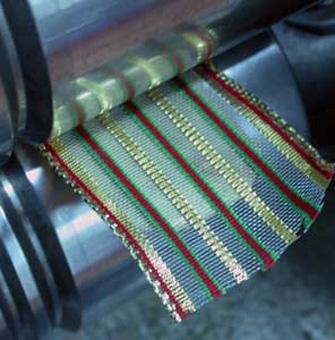
And put it in my roller like this. I just get the front edge and the cloth and then I tighten the roller down nice and (tight). I roll the metal plate through in in one motiion.

I have rolled mosquito gauze and bandages (those loose ones), flattened steel wool, shavings from a lathe or drill press and even dishcloths. All give interesting textures. The backing metal is the flattened and soldered to the onion in the normal goldsmithing manner. The textured piece is held level in a third arm and the cast onion is placed on top and soldered. The excess plate is cut off and filed down.

The awl is soldered on. I solder the lower part of the awl first, and then only put solder on the top. I never try solder both at once. To often, it ends up being problematic.

I made a little leaf shaped 'spritz' that had paved emeralds to be set in later. I filed the little lug onto it and drilled a hole in the onion body of the piece at the right angle. This ensures a neat solder joint.

Before that was soldered, I drilled a few of the holes in the onion for the diamonds, to make rinsing easier after it was pickled in acid. I then made the roots. I took four pieces of wire and fused them together using the Metal Finishing Fusing Technique. The reason I fuse the roots, is because that way, when I solder them on they can't move. A bit like a very hard solder. Once that is finished, I use needle files and a sanding disk (Moore's white plastic disks) to get them looking a bit like roots. Not very long or sharp.

Partially polished and being set. Then everything is finished off, final polishing is done.

The completed hollow onion pendant from wax carving into gold set with diamonds and gemstones.
Often custom orders have very specific symbolism build into their creation which needs careful planning and consideration to achieve the desired result. In this case the suitable approach was hollow carving the onion in wax , casting and hand finishing the pendant.
or select other projects from Jewelry Making Tutorials List
If you have any questions or wish to be notified of any new tutorials that are posted, email me.

This content is the intellectual property of Hans Meevis. More information on our Copyright and Privacy Policy