Jewelry Studio of Hans Meevis       

Jewelry Designer of fine custom
art jewelry

Jewelry Gallery
  New Designs
  Larimar Jewelry
  Titanium Jewelry
  For the Man - Titanium
  St Maarten Map Jewelry
  Jewelry Catalog
  Objets D'Art
Jewelry Class
  Jewelry Making Class List
  Ingot
  Wax and Titanium
  Casting
  Purple Gold
  Composite metals
  Titanium Bangle
  Repoussé Work
  Gem Carving
About us
  A note from Hans
  Studio Pictures
News
  Blog
   Jewelry Trends
  Custom Catalog
  Custom Jewelry
  Newsletter
Contact us
  Order Jewelry
  Email
  Address
  Map
Navigation
  Site Map
  Home


Jewelry Making Class

Making a Panel Ring: Part 1

Degree of difficulty: Intermediate

This 'How I Do It' (Hidi) is the first part of making a panel ring, or a plate ring. This tutorial needs you to be familiar with basic goldsmithing techniques. These rings are an industry standard in many different shapes and sizes. These days it is easy to pick up the phone and order one to size from a supply company, but making one is a good skill to have, as this two part Hidi will show. They are normally  open/hollow , but can also be closed/hollow, in  which case they are quite heavy. I am going to make a closed/hollow one and show how a open one would be completed..

I start with a piece of plate about 70mm long and 14mm wide and 1.30 mm thick.. This piece of metal is shown is longer, because I always start with a longer piece, or a bigger piece of material when I start anything. The reason for this is because it is much easier to cut things shorter than longer.

I bend it like this. I use half round pliers and ring bending pliers and a swage block.

And I file it to this shape. Now from the previous picture and this one , quite a lot of metal has been filed away. I use a big 15 inch Bastard file on my peg.. It is not necessary to do this, however. One can pierce the plate to an approximate shape and the file it true.

I draw out my shape on a piece of paper, and then as shown on the left, check if I like the taper, width, and balance. Then when I am happy, I glue it down on a piece of plate and pierce it out.

The band is laid on the side plate and only one side is scribed.

And then the first side is cut and filed until it fits and only then is the other side is scribed and cut. And also made to fit by filing accurately. The tighter the fit the better the solder joint.

Both sides have been fitted more or less. Now the top left hand corner has to be tacked with solder.

Solder is placed in the top corner and

just allowed to flow.  With a small solder joint it is easy to see if everything is true and adjust if it is not.

.

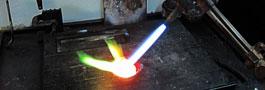
Then the ring is held in the third arm like this and the left side is soldered. The top right-hand side is not flush so now is the time to adjust it before soldering. I use the third arm instead of laying it flat because it is easier to control the solder heat in the third arm and that results in a neat solder join ...

like this. This is important, because this ring has long solder joints, and the risk of a solder hole is high. So the better the solder the less matata (trouble) afterwards.

Once the soldering is complete I use a ring sizer as a guide to scribe the circle I am going to pierce out.

I put the saw blade through the ring and saw the side out on my sawing peg..

I'll file it smooth after I solder the other side in.

So now I have soldered the second side in and then I turn it around and pierce the second side like the first.

Here she is pierced out and sanded up to 220 grit sandpaper. Now is a good time to check that the solder joints are well soldered, with no pits and gaps.. Also, I do not sand past 220 because there is plenty more soldering to do. And since I only use one grade solder (hard), I don't sand down too far in grit size. The reason is that if one heats up completely sanded down solder, it will form a sunken little groove. This causes more sanding to be done, thus making the piece thinner. So I try to keep soldering with rough sanding  together and then go to 1200 once only.  If  I was going to make a hollow open panel ring I will skip the next step, of putting an inside piece in.

This is how I measure the inside piece.. I take a piece of paper and rub it with my finger so that is makes an impression on it.

Then I stretch it out and glue it down with clear Bostik glue. And I pierce it out. Much easier than trying to file a piece down and messing around making it fit.

This picture I have deliberately left the inner piece proud, for the photo. Before I solder, it will be flush and neat.

Soldered and sanded to 220.

.

For a hollow ring, I roll out the top. A piece of gold that can be anything from .7mm to 2mm thick, depending what I am going to do with the ring. Sometimes the top needs heavy texturing or setting stones in it. This picture shows a open hollow ring being made. Most panel rings are made like this, because it makes making a mould of the ring easier. However, a better quality ring is one that is closed on the inside. I decided to make a closed one because in the tutorial after this one I am going to make a mould with it and then inject it with casting wax and further carve it.

Lots of flux and a soft bushy flame and plenty of solder makes for a good solder joint. The top would then be trimmed off and the  ring is finished off and made ready for setting. Or changing the shape , as part two of this Hidi will show..

Okay, so the basic shape is finished. Now I am going to make a mould for the ring and then I am going to use this ring and change the design in part 2 of this Hidi . After all, this ring is just a blank canvas at the moment.

End of Part One


Airport Boulevard #65, Simpson Bay, Sint Maarten,  Netherlands Antilles
Tel: +(599) 522-4433 Fax: +(599) 545-2922
E-Mail: jewelry@meevis.com

More information on our Privacy Policy