|
This Hidi is by request. I
have received many e-mails asking me to show some pictures
of when I make a fused ring. So I made two rings. One an
18kt yellow gold ring and the other a silver ring, fused
with 14ct gold. These type of rings are very good sellers
for me, and in fact whether fused work is done in pendants,
rings, earrings or bracelets, the results are very popular.


START.

I start with a piece of
rolled out metal, silver on the left and gold on the right.
The silver is 2mm thick and the gold is 1.5mm thick. It is
quite alright to bend the ring round now and then do the
fusing, but I prefer to bend them round after the
reticulating is finished. If I have to form the metal
extensively, I will do that first, because the reticulating
makes the surface porous and the metal somewhat brittle.
Especially thin metal, like .7mm

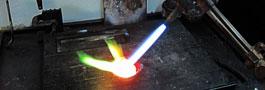
This is the flame I
reticulate with, set with plenty of oxygen. This Hidi is all
about the type of flame and how it is controlled. More
oxygen causes the outside metal to 'freeze' because of the
oxide layer and with more gas, a reducing flame causes the
metal to run and flow on the outside. A bit like the skin on
boiled milk
Notice how the silver
starts becoming 'crishy'. This is just before it melts, but
since the flame is set with too much oxygen, the surface
forms an oxide layer and the silver melts and moves under
this layer, causing the typical wrinkles of reticulated
work.

This is the 18kt being
melted. I will pull my flame away at this precise instant,
and move to the next section of the gold.

The result then looks like
this.

And this is what my metal
looks like after it is pickled.

And this is what it looks
like after a light polish, with the polish not cleaned off,
to show the texture more clearly. I now bend the rings
round. Generally, the metal is not too brittle and the
bending is easy.

Like this. I am not worried
about the joints, because I am going to fuse them closed.

I fuse them closed with a
1mm piece of wire, used exactly like a brazing rod. I don't
use any flux, because I want the surface to be rough. I use
a hot flame, but with a bit more propane gas, to allow the
metal to flow just a little bit easier. The trick is to heat
the thicker metal first, just under the melting point, and
then to apply the wire at the right time. This does take a
little practice to get right but hey, if you make a mistake,
you simple melt it all down and start again. It is only on
your fifth attempt that you are allowed to start cussing.

There was, in this case, no
cussing needed. So now , the next thing is to add some 14kt
gold to the silver ring and some 18kt gold to the 18ct ring.
It is not possible to add 18kt gold to the silver ring for
instance, because the 18kt's melting temperature is higher
than the silver. For the purposes of this Hidi, it is better
to fuse with metals that are of a lower melting point than
the 'parent' metal.

Here I am about to start
fusing 18kt wire. The ring is already very hot.

Now I fuse both metals
together.

And I remove the wire at
the right time.

Further fusing of the 18kt
ring. Notice the flame is 'normal'. Not to much oxygen, nor
to much gas.

Fusing 14kt gold onto the
silver ring. One thing is that if the ring is over heated,
the 14kt will sink in the silver, basically making a form of
solder. That screws the job up. Careful heat control is
necessary.

Adding some more in a
different spot.-- Just as a matter of technique, my left
hand is resting lightly with my pinkie extended on my third
arm. That makes my gold wire steady. Also, I am sitting
comfortably, with my elbows in an easy position.

From a different angle. The
torch flame is at about 45 degrees and the ring is very hot,
but because the silver has a higher melting temperature, it
is brought up to the 14kt's melting temperature. But not
above. Otherwise the 14kt will either run around and flood
large areas of the ring. This is not what I want. So it is
better to brush your flame on the piece, then away, then on
the piece, then away. Close, then further away. It allows
for a more controlled heating of the piece. If the gold
melts before the silver, it meant that I was impatient in
heating up my silver piece. Which has the bigger mass, so
therefore it takes longer to heat. And when I say longer I
mean less than five seconds.

These are the two rings
that have been freshly fused. The silver ring was fused
closed with silver and you can see the joint at 12 o 'clock
The 18kt ring has a little bumple at 11o'clock that needs to
be filed out and the silver ring has a big wart at six o'
clock that will suffer the same fate.

Six o'clock bumple filed
down.

Six o' clock bumple re-
fused.

This is the silver ring
with a light polish on the outside and the inside finished
off. The first picture in the Hidi is the ring with liver of
sulphur applied. Liver of sulphur is potassium
polysulphide and is available at most jewellery tools
suppliers. Also, one can use calcium polysulphide
which is sold in gardening shops as 'lime-sulphur', and is
used as a fungicide. Much cheaper and much easier to obtain.

Here is the unset18kt ring.
I like this type of ring 'as is' but I did put the
bumples on to set diamonds in.

So this is the final model.
Cute, in' it?

A set of three 'stackable'
rings that are so popular these days. The centre ring is
white gold.
As usual, I grant any
entity the right to use this work for any purpose without
any conditions. If you want to leave comments of suggestion
or requests, contact me at
hansmeevis@gmail.com
Also. I you like the jewellery I make , check out my
blog, which I update about twice a week, at
http://hansmeevis.blogspot.com
|