Jewelry Studio of Hans Meevis       

Jewelry Designer of fine custom
art jewelry

Jewelry Gallery
  New Designs
  Larimar Jewelry
  Titanium Jewelry
  For the Man - Titanium
  St Maarten Map Jewelry
  Jewelry Catalog
  Categories of Jewelry
  Custom Catalog
  Objets D'Art
Jewelry Class
  Jewelry Tutorials
  Ingot
  Wax and Titanium
  Casting
  Purple Gold
  Composite metals
  Titanium Bangle
  Repoussé Work
  Gem Carving
About us
  Who are we
  A note from Hans
  Studio Pictures
News
  Jewelry Trends
  Before/After Remodeling
  Custom Jewelry
  Newsletter
  Blog
Contact us
  Order Jewelry
  Email
  Address
  Map
Navigation
  Site Map
  Home


Jewelry Making Class

Making a Plique-a-Jour Fairy.

This is a HIDI, (How I Do It). It is not the only way to make a piece like this, there are probably better ways, but this one worked for me.  I also assume you are familiar with all the basic goldsmithing techniques.

v

 This is a 'classical' design of a fairy ( to me ) and is by no means my own design. Rather, is is a modern replica of a model that was made in about 1912 during the Art Nouveau period of that time.

The first thing I do is to carve the body out of wax. I use Ferris Purple wax, but if I do another one I would carve it out of a green wax. I found the purple a bit too soft for the detail on the face. The face I carved under a microscope. For a Hidi on carving, see http://www.meevis.com/jewelry-making-class-carving-egret.htm

Here is a picture after about 3 hours of carving. I am going to carve the back of the body, and then the face last. This is always problematic, because it is easy to damage the finer detail on one side when I work on the other side.

So I make a bed for her. I cut a short section of aluminium U channel, and then mix up some of that two component epoxy putty that can be bought at a motor spares shop. It is used for fixing exhausts and sealing your mother-in-laws mouth. I press it into the channeling and then put a piece of cling wrap over it. Then I gently and oh-so carefully press the model into it. The cling wrap stops the putty sticking to the model. I pull the model out and then, after the putty has hardened, file it down like in the picture. I do this for all four sides of the model. These are handy for support when I carve further and it stops the model getting damaged on the opposite side to the side being carved.

This is my bench I am carving at. The piece is mounted in the engravers ball, and I am using a stereo microscope with various picture of a woman's anatomy, like hands, feet, faces etc in pictures around me. It is absolutely essential to carve with reference pictures.

How inelegant. Shame, the poor thing. Anyway, she is cast in the normal manner. I used a spin caster. I did make a silicone mould first, just in case the cast did not come out properly. Notice the thick sprue--taking no chances.

It cast perfectly. Now I use these epoxy bed also to hold her while I finish the gold off.

Here I finish off her back and hair here the sprue was joined.

Now the wings. I first have finished her halfway off and only now do I start designing the wings. Much easier to get a good perspective. I draw one side out on paper, then once I am satisfied, I tidy it up, scan it into Photoshop and mirror the image. So then I have two perfect wings. These are then printed out and glued onto a piece of 18 karat gold that has been rolled out to 1.2 millimeters thick.

But first, I made one out of silver, to test the whole balance and also to experiment with the colors of enamel I will use.

Like this. If you look at the final picture of her wings, you will see that they are not the same as the test wing. The reason for this extra effort is also that the gold wings must be soldered to the body, and then enameled. So there is only one chance to get the enamel right. Therefore, it is much easier to make a sample wing and screw it up than to screw the whole piece up...right?

Once the wings were pierced out, (using a No 6 saw blade), they were cleaned up, filed and sanded and soldered together at the center. Here I am tapping holes into her body and screwing the wings in place. The screws are made with a watchmakers tap and die set.

 Then I soldered a piece of scrap gold to the front so they would not move while the brooch mechanism and pendant hangers thingamabobs were attached. The chain threads through the three loops.  In this piece, only hard solder can be used because of the enameling to come.

Here the piece is in my soldering tweezers. Another piece of wire has been temporarily soldered to the bottom of the wings to stop any movement. A cooling paste has been smeared over the previous solder joints, not to keep things cool actually, but rather to stop anything moving when it reaches soldering temperature.. The wings have been screwed into the body with a layer of solder in between the wing and the body. This was a difficult soldering job because the wings are very light and the body much heavier. So it is VERY easy to melt the wings..

The wings are soldered on and the pin is temporality put in place. Next is to set the diamonds and give everything a light polish before the enameling starts.

I use Jet Set to hold everything in place. When I set small diamonds like this I use a punch to force the metal over. It makes the setting very neat, and once you get the hang of it much faster to. The jet set is removed, and the whole piece is cleaned in acetone and polished and made ready for enameling.

THE ENAMELING PROCESS.

My method of enameling is unorthodox.

I put a thin layer (.05mm)of  annealed copper behind the wings. I carefully cut it out and bend it over the edges. The design was such that I has to make two little caps for the tips, and I took this picture just to show the caps. The trick here is to get the copper flush against the wing lattice, so that when the enamel melts, it does not run between the copper and gold.

A rear view of the wings.

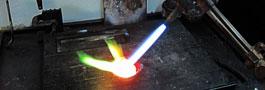
Here the enamel is about to be fired with a torch on my bench. I use a soft, largish flame. It is very easy to do, much more so that using a oven, at this stage, because you can see exactly where the enamel needs more heat. I use a 2mm thick stainless steel gauze, bent in a V for the wings shape. On the top of the right wing, at two o clock, two rivets are blocked out. There is one more blocked out one under the wing. This is to stop the flame from over heating the brooch catch.

After the first firing I add another layer, checking carefully for any bubbles and uncovered areas. Normally only two firings are necessary because by then the enamel is thick enough for finishing off.

The normal way to do plique a 'jour takes forever, and requires many oven firings. To see a tutorial on traditional enameling check out : http://www.jewelryartistmagazine.com/stepbystep/dec02.cfm

After the second layer of enamel has been fired the copper is peeled off the back.

Ok, so I am using another picture to show what I mean by 'peeling off' ( I got so hung up on the fairy, I forgot to take pictures as I went along :) Anyway, the copper peels of easily, leaving behind a thin layer of copper oxide. This I sand down with a normal sanding mandrel with 220 grit sandpaper. The type used for sanding the inside of a ring. This, along with rubber wheels and some diamond burrs, cleans the copper oxide off. The diamond burrs are also used to clean any glass that is stuck on the lattice of the wing. All the enamel must be cleaned off. If there are any pits in the glass I use some Nitric acid to clean them out. In fact, I use a paintbrush and lightly paint nitric acid on the back of the enamel for about 15 seconds or so just to get it super clean. Care must be taken though, because the nitric will attack the enamel.

She is now sanded down and cleaned and ready for final firing in a oven. Depending on the enamels and oven  used this is at about 780C for two to three minutes. This allows the glass to flame polish, thus giving it the enameled shiny look. Once the enameled is fired to the right gloss, I let the piece sit in the over at 500C for about an hour and then I switch the oven off and let it cool down to room temperature. That takes care of the annealing of the glass. It would be prone to crack otherwise. I pickle it in dilute sulphuric acid (battery acid) just long enough to loosen the oxide. Later I thought that Sparex would be a much better solution. I left the test wing in sulphuric acid for about 20 minutes and the acid did attack the opalescent enamels.

Difficult to photograph. This photograph for the enamel, and it shows quite nicely. The enamels used in this project were from Thompson Enamels at http://www.thompsonenamel.com/ and they were

Nitric Blue No. 2660, Opalescent Green No. 2300, Opalescent White No. 2061

Sanding mandrel, diamond burrs, and grey rubber wheels. were used to finish the back and front of the wings, and 1200 grit sanding mandrel is used prior to final firing.

The piece weighs 20 .5 grams, and took about 60 hours to complete.

Any comments or suggestions can be sent to: hansmeevis@gmail.com


Airport Boulevard #65, Simpson Bay, Sint Maarten,  Netherlands Antilles
Tel: +(599) 522-4433 Fax: +(599) 545-2922
E-Mail: jewelry@meevis.com

More information on our Privacy Policy