Jewelry Studio of Hans Meevis       

Jewelry Designer of fine custom
art jewelry

Jewelry Gallery
  New Designs
  Larimar Jewelry
  Titanium Jewelry
  For the Man - Titanium
  St Maarten Map Jewelry
  Jewelry Catalog
  Objets D'Art
Jewelry Class
  Ingot
  Wax and Titanium
  Casting
  Purple Gold
  Composite metals
  Titanium Bangle
  Repoussé Work
  Gem Carving
About us
  A note from Hans
  Studio Pictures
News
  Blog
   Jewelry Trends
  Custom Catalog
  Custom Jewelry
  Newsletter
Contact us
  Order Jewelry
  Email
  Address
  Map
Navigation
  Site Map
  Home


\


Jewelry Making Class

Making a Fused Pendant.

As usual, this ' How I Do It' (Hidi) assumes that you are familiar with basic goldsmithing techniques. Although I am using 18ct yellow gold in this tutorial, one can use 14ct or silver equally well.

Here I have a rolled out a piece of plate and a strip of metal. Both are about 1mm thick, but pretty much any thickness can be used.

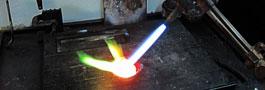
I hold the pieces in my spring tweezers when I fuse them. The flame is hot but not too much oxygen, because that causes the metal to boil and lots of bubbles and brittleness are the result then. A too soft flame will result in the whole piece heating up and collapsing as it looses strength.

Here the flame is melting the joint. It is hot enough to melt just at the joint and no further. As soon as it is tacked I pull the flame away.

There is is fused. I used the 'little Torch with a no.6 nozzle. Oxygen and propane gas is the fuel.

This is how I fuse the gold into the shape as is shown in the next photo. This technique is used throughout the construction of this pendant.

This is nice fusing, clean, not pourous and controlled. This is something that, to a beginner that is viewing this post, can be learnt easily by practicing on off cut pieces of metal. Play around, 'weld' them in odd shapes, polish the results and look at them with an Optivisor or some other magnification to see how you get the best results. The least porosity means your flame and temperature were good....There will always be a measure of porosity, which I think is part or the 'look'. But sometimes I want it smoothed out. Then I hammer it down with a rotary burr that I have made out of tungsten carbide.

This was a ball frazer that I bent by heating it  after I ground the teeth off. It is then polished. Normal steel burrs can also be used, but tungsten lasts much longer

Okay, with that all out the way, this is how I start actually making the pendant. First I only fuse the two ends onto the plate, after bending the correct curve. ( in relation to the curve of the aquamarine)
 

Here I have fused the top and sort of fused the 'bottom' curve. All I am doing at this stage is 'tacking' on the various pieces. I use no solder at all as the next few pictures show. In fact, no solder is used at all in this pendant.

Here I have curved the bottom and rolled out the side (left) . I also pre- fused the left side and then tacked it to the top and the first curve. I you fuse to much, you can always file the excess off and re-fuse. If it is to little, a small piece of wire or scrap is used to build it up.

This shows the piece without the Aqua in it. Note the non soldered section. I will get around to that later. The centre has been pierced out so that the pavilion of the aqua can lie in the top of the fused sides. This is done so that the setting of the stone is easier later on.

After the plate has been pierced out (piercing is sawing with a no 3 jewellers blade) I am going to fuse it. This is easy, because all you have to do is angle the flame at a more or less 45º and it will flow. By the way, I use no flux at all. Rather, I use a flame that is just not oxidizing

Here it is fused

.

Dang, these photo's were taken on the fly, so their quality is somewhat dubious:) Anyway this is the bail fused on. I pre-fuse the bail, bend it into shape and then fuse it on to the pendant.

Different view.

I have added various blobs where I am going to set some diamonds in. As I settle the aqua in I will burr away where necessary and fuse more also where necessary

The pendant is too 'heavy' on the sides so I drill holes in it to fuse later. I am also going to pierce the front and fuse it later.

Like this

I then fused a claw in at 12'o'clock and set the Aqua after I had polished it. I use very little sanding on work like this because it removes too much texture. Rather I just check that there are no file marks etc and then a normal polish and rouge.

The carving tutorial of the Aquamarine can be found at:

I hope you enjoyed this Hidi and as usual, any questions, suggestions or better ideas can be sent to me at hans(at)meevis.com


Airport Boulevard #65, Simpson Bay, Sint Maarten,  Netherlands Antilles
Tel: +(599) 522-4433 Fax: +(599) 545-2922
E-Mail: jewelry@meevis.com

More information on our Privacy Policy